Your AI engineering team, equipped to deliver.

AxiaCraft brings the work, the agents and the controls into one place. Start with a business prototype in the Gallery, a product brief or an existing application. Give agents the right skills and tools, choose how they use AI, and follow delivery through to review and release.

Installed inside your own environment, with people deciding what matters and where approval is needed.

Turn an idea into work the team can finish.

Start with a product brief, a prototype or an existing application. AxiaCraft helps turn the outcome you want into a plan, a prioritised backlog and manageable rounds of work.

  • Give every product a workspace. Keep tasks, decisions, agent activity and progress together on a board.
  • Build a team around the work. Assign a lead, developers and specialist reviewers. Set how many agents can work on the board.
  • Keep delivery moving. Plan sprints, track what is ready or blocked, and choose whether completed stages advance automatically or wait for approval.

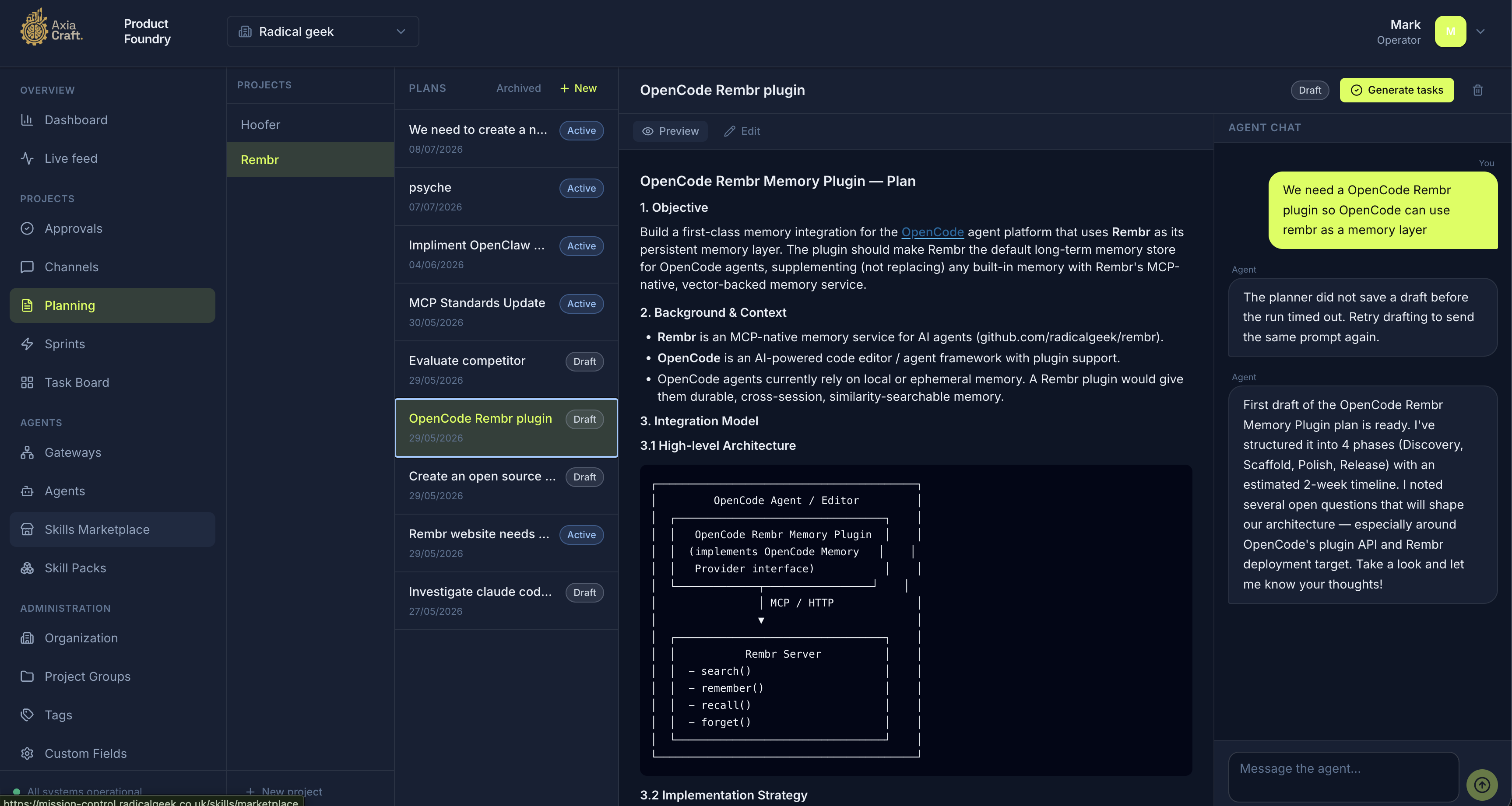
In practice: A request to improve an internal booking tool becomes a visible plan, assigned tasks and a reviewed release.

AxiaCraft planning workspace showing a product plan and agent discussion
Real AxiaCraft interface · planning a product with the team

Give agents the know-how and access they need.

A skill explains how to do a job. A tool lets an agent take an action or get information from a system. AxiaCraft manages both.

02 · Managed skills

Make your way of working reusable.

Package instructions, procedures and supporting material into skills that agents can use across projects.

  • Browse and manage skills in a central catalogue.
  • Group related skills into packs and update them from connected sources, so teams can share the same guidance.
  • Give agents the team’s default skills or choose a specific set for each role.
  • Reuse your architecture standards, review checklists and delivery conventions.

For example: Use Gallery skills in Codex or Claude to prepare and upload a prototype. Inside AxiaCraft, give developers your build guidance and reviewers your security checklist.

03 · Managed tools

Control which systems agents can use.

Bring connections to engineering tools, data services and operational systems into a managed catalogue.

  • Discover integrations, choose a known version and review it before making it available.
  • Keep connection settings together and refer to securely stored credentials.
  • Choose which teams, roles, agents or tasks can use a tool, what they can do and how long access lasts.
  • See installation and health status, and withdraw access when a tool is no longer approved.

For example: Give a reviewer read access to service logs while keeping deployment access with the agents authorised to release.

Choose the right AI for each kind of work.

Model routing means deciding which AI model handles a request. AxiaCraft’s model gateway keeps those choices in one controlled place, so you can change providers or models without rewriting each agent.

Configure the approach.

  • Routine work: use a lower-cost model for coordination, estimates and status checks.
  • Development: route implementation work to the model selected for that role.
  • Specialist review: collect the relevant evidence, ask different models to assess it, and bring their findings together.

Keep the choices visible.

  • Manage model names, prices, credentials and selection rules centrally.
  • Record which route was used, why it was chosen, how long it took and what it cost.
  • Use a configured fallback when the normal routing approach needs an operator intervention.

In practice: A simple progress check uses a modest model budget; a security review can draw on several independent assessments.

The September case study uses Fireworks.ai models through LiteLLM, the central model gateway. Providers and available routing choices depend on the installed configuration.

Set a spending limit that the agents work within.

See what model work costs and control how quickly it can spend. The shared AI budget applies across active teams, so adding another team does not give it a separate allowance to spend unchecked.

  • Check before spending. Reserve the estimated cost before a model request starts, then record the actual usage.
  • Wait when the budget is full. Work pauses until budget becomes available and then resumes the same task.
  • Bound expensive work. Limit request sizes, output sizes, model calls and time spent on a single request.
  • Avoid repeat charges. Duplicate protection limits repeated final reviews; idle teams can stay quiet without routine model polling.
  • Trace costs to useful work. Follow usage by project, sprint, task and run, with alerts as limits are approached.
  • Keep estimates identifiable. Operational cost records support budgeting; provider billing remains the financial record.
Example from the case study£2.96 per rolling 15 minutes

This was the shared AI spending limit used in the study. Teams waited when it was full and continued when capacity became available. Your installation’s limit is configured to suit your workload.

Explore the cost model →

The model budget controls AI-provider spending. Infrastructure, hosting, licence and support are separate costs.
Make review part of the delivery process.

Development work passes through quality, security and architecture review. Findings become work the team can act on, with the outcome visible alongside the original task.

  • Require review before work can be marked complete.
  • Keep test evidence, review comments and decisions attached to delivery.
  • Set approval points for your project, including when people need to intervene.
  • Connect the process to your repositories, build checks and release pipelines.

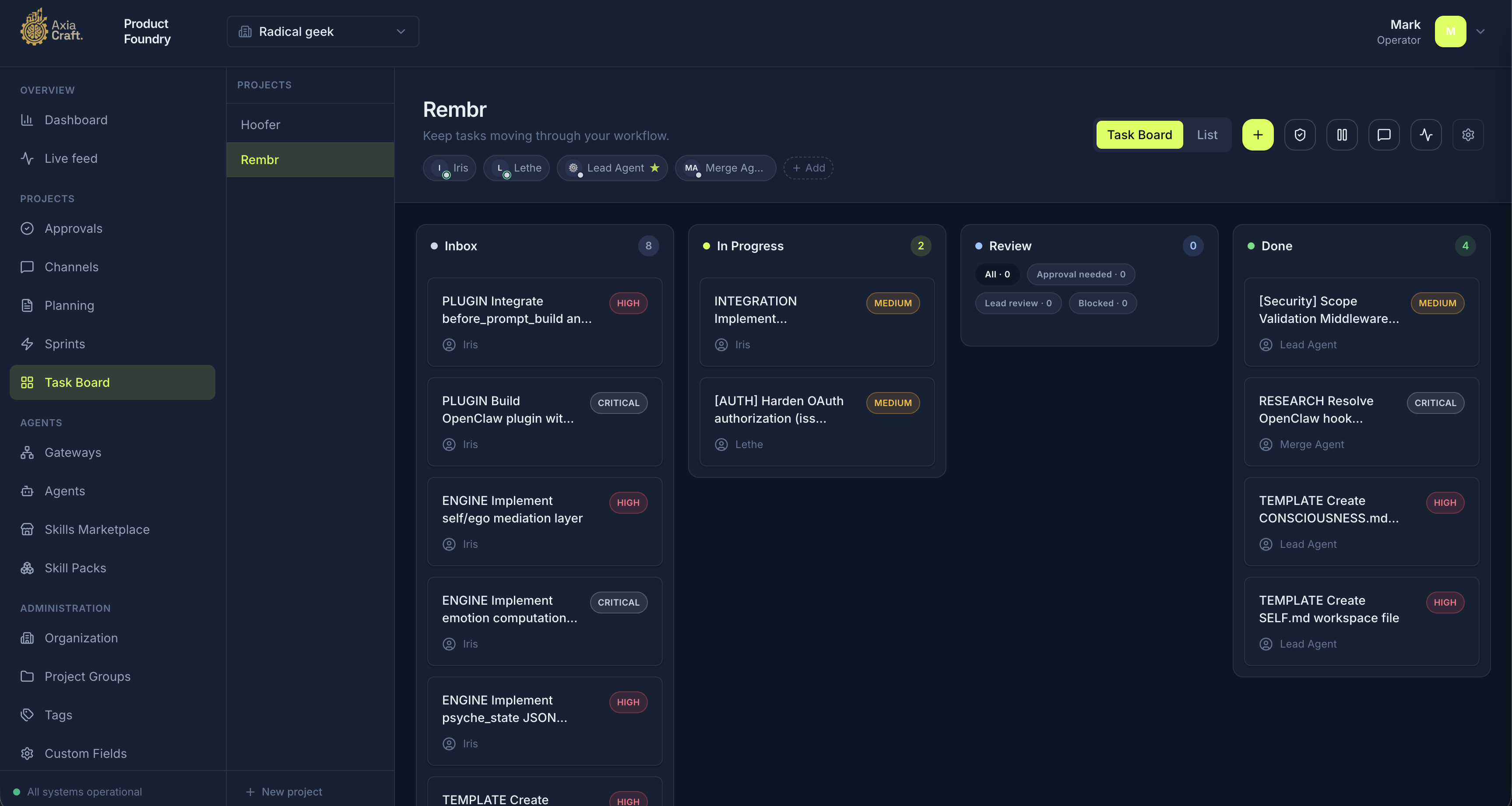
In practice: A review finding becomes an assigned fix, returns through review and is checked before the team moves on.

AxiaCraft task board showing work assigned to agents across delivery and review stages
Real AxiaCraft interface · work, ownership and review status

Fit the factory to your organisation.

Control the environment, the team and the way work moves. Configuration is shared where it should be consistent and tailored where a project needs different rules.

Organisation and environment

  • Manage organisations, users, administrators and access to boards.
  • Connect and monitor the services that run your agents.
  • Configure repositories, service connections, credentials and event integrations.
  • Apply your product identity and appearance, with organisation-specific overrides where needed.

Team and delivery

  • Choose agent roles, instructions, skills and tool access.
  • Set team size, review requirements and approval rules.
  • Choose automatic backlog organisation and sprint progression for the boards that need them.
  • Configure model routes, available providers and spending controls.

Configuration spans AxiaCraft, the services running your agents and the central model gateway. These are connected during installation and documented for your operators.

Keep context as the product grows.

The next round of work should build on what the team already knows. Shared memory keeps useful decisions and project context available, while the work history shows how the product reached its current state.

Carry decisions forward.

Store and retrieve project notes, constraints and previous decisions. Board and shared memory give agents a common reference; Rembr can provide the connected long-term memory layer.

Bring new work back into the process.

Connect product feedback, service events and external systems through APIs and webhooks—connections that pass requests and events between systems. Route incoming information to the right board or agent, then follow it through planning, delivery and review.

Start with your first real application.

The four-week entry installation connects the factory to your environment, proves the workflow on an agreed application and hands it over to your team.

£20,000 installation + £1,000/month licence

Agreed entry scope, excluding VAT. Optional support packages include the licence. Infrastructure and AI usage are paid separately.